


A honky-tonk
 can be many things, spelled many ways and shortened into one word. When you are referring to a bar with live music in the Southern and Southwestern United States it is also called a honkatonk, honkey-tonk, or tonk. The earliest use of the word (spelled "honkatonk") was an article published in 1900 by the New York Sun and widely reprinted in other newspapers. It was said that the term came from the honking of geese, which led an unsuspecting group of cowboys to the geese instead of a variety show they expected. The "tonk"part is said to have come from the large upright pianos popular in Tin Pan Alley
 songwriting emporiums made by William Tonk & Bros.
Another more plausible explanation for honky was that it was a term for white people, derived from bohunk and hunky. In the early 1900s, these were derogatory terms for northern Europeans from Poland and Hungary. Robert Hendrickson, author of the Encyclopedia of Word and Phrase Origins
 , wrote that Black workers in Chicago meatpacking plants picked up the term from white workers and began applying it indiscriminately to all Caucasians.
 It seems likely that a honky-tonk was an urban equivalent of the country jook joint, a lower-class bar catering mainly to men. A lyric from one of the pieces of sheet music above, the 1916 hit song "Down in Honky Tonk Town
 "explains "It's underneath the ground, where all the fun is found." Both sheet music covers show a raucous dance scene.
Over time, the music that was being played in these places became synonymous with the term for the establishments, though the music changed over time just as the clientele did and so we end up with at least two different styles of music with similar origins.
Musically honky tonks were first piano pieces: Jelly Roll Morton
 's 1938 record "Honky Tonk Music" and Meade Lux Lewis
 's big hit "Honky Tonk Train Blues" are two good examples. In the fifties it turns up again as a twelve-bar blues instrumental "Honky Tonk" by the Bill Doggett
  Combo that became an early rock and roll hit. Fats Domino was often referred to as a honky tonk piano man so its place in New Orleans musical history is secured. Other honky-tonk songs recorded by New Orleans musicians include Louis Armstrong
 , Walter "Wolfman" Washington, Peter Bocage
 , Panorama Jazz Band, Tuts Washington
 , Dave Bartholomew
 , Storyville Stompers
 , Nappy Lamare, the Eureka Brass Band
 and Nicholas Payton.
Another type of music using this term is a country music style which arose from the Thirties "Western Swing" movement pioneered by Bob Wills
 . His radio and recordings became the standard for modern country and western in the Fifties and beyond. A good example is Hank Williams
 1951 hit "Honky Tonk Blues," Louisianian Harry Choates
 ' "Honky-Tonking Days" and Charlie Feather
 's "Honky Tonk Man."
More modern music fans would also want to point to "Honky Tonk Women
 ," a 1969 hit song by The Rolling Stones
 . In this song a "honky tonk woman" refers to a dancing girl in a western bar who may work as a prostitute. Wrestling fans would want Roy Wayne Farris mentioned as his ring name was The Honky Tonk Man.
If you think that Honky-tonks
 are dead you couldn't be further from the truth; recent research has turned up two present day honky-tonks, one near Baton Rouge
 and one in the middle of Florida. There are probably a lot more and if someone who reads this runs a nice magazine, I'd be glad to go and do some field research and come back with a much bigger piece of the story. Here in New Orleans the original "Down In Honky Tonk Town
 ," has been adopted and adapted to traditional New Orleans jazz so in that way the original song can still be heard though time seems ripe for an updated honk tonk to appear as this term continues into the 21st Century.


 hell or as I refer to it "I'm my own grandpa!" The song "I'm my own grandpa!"was a novelty song written by Dwight Latham and
  , first performed by Lonzo and Oscar in
  . The song tells the story of a man who, through a combination of marriages, becomes stepfather to his own stepmother, in essence he becomes his own
  .
. ). These lists were written anytime great aunt what's-her-name would come to visit and they would start talking about dead relatives. These lists sometimes had no rhyme or reason as to where the dates and marriages and
  were placed. One day I spent an hour or more with a distant relative whose first name was Olive. I thought she would be a girl until I saw that he/she got married to a girl. Then I thought maybe there were two Olives in different branches as there were many Thomases, Williams and Elizabeths. Finally I realized the marriage date had to be wrong as
  would have been married at 8 years old and the marriage was her father's, not hers. Yep, I'm my own Grandpa.
 on another; there's even a Dutch relative from 1725. My life is now filled with Gilpins, Aungers, Dobills, Faatzes and Andrews that I never realized were a part of me. I also know more about the Olvers, Crosses and
  than I ever did before. Old pictures of the family mean something now as I can look them up in the software and add their pictures to their names. But many questions weren't answered and I am still not sure whether I entered everything correctly; the software keeps telling me that "I'm my own grandpa."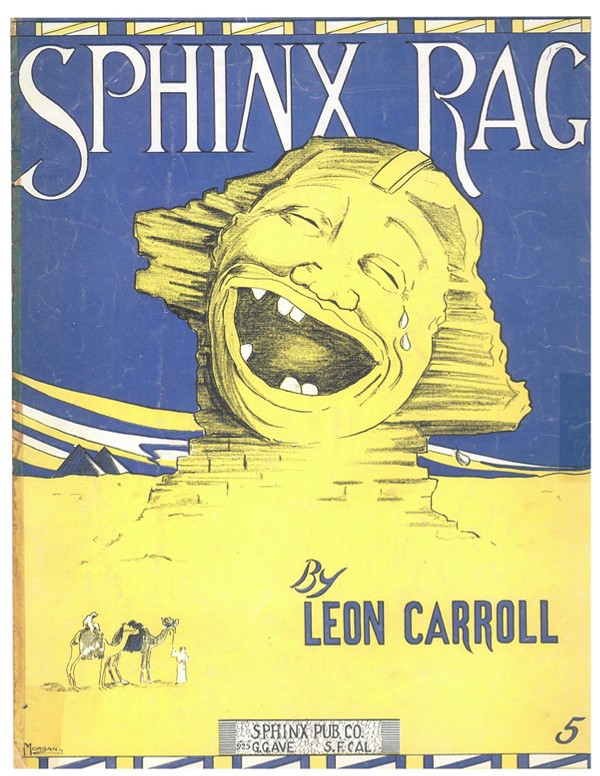
 . I started collecting sheet music about 25 years ago while sitting in an antique store waiting for my wife to finish shopping. I discovered a pile of sheets and started looking through, quickly discovering a sheet from an early
  called "
 ." I quickly fell in love with the graphics on the covers and realized how much sheet music reflected what was popular in popular culture in any specific year. My love of sheet music led to my in-depth research of African American songwriters and thus to my award winning first book, "
 ."
." , the large on-line auction house. Everyday there are thousands of sheets for sale, with new ones arriving all the time. I have used eBay as a way to not only keep up with the prices of some of my rarer sheets but also to buy ones that were previously hard to get. I have also used eBay as a way to collect the images of sheets that I am interested in just for just the covers and don't want to plunk down the cash to buy. Over the years, as I examined sheet after sheet, trends in popular culture became more evident.

 discovered the tomb of King Tutankhamen, thus bringing the Golden Age of the
 to life. Sheet music and Americans were interested in
 before this, particularly the most visible long-lived monuments of the pyramids and the
  to see the exhibit and was blown away, like others, by the riches recovered from the burial site. Just like in the early twenties, America went Egypt crazy, with the most visible sign being an American comic,
  , making his living for a few months with a song and skit dedicated to the noble boy king.
 or at least is portrayed as such in a sheet from that time. Now I know that the Sphinx has its origins in sculpted figures of
 with female human heads but I never knew it went below the neck line. So here is the proof below; take it with a grain of salt as many times illustrators of sheet music never really saw their subjects.

 : only time will tell.

